
India’s digital transformation is entering a defining phase. According to a newly released report, “Estimation and Measurement of India’s Digital Economy” by the Ministry of Electronics and Information Technology (MeitY), the digital economy accounted for 11.74% of national income in FY23, equivalent to nearly ₹31.64 lakh crore (~USD 402 billion). By 2030, it is projected to contribute close to 20% of GDP, nearly double its current share.
A Landmark Measurement Exercise
For the first time, India has produced a credible estimate of its digital economy using the OECD framework, joining a select group of nations and becoming the first developing country to do so. The report also includes alternate estimates using the Asian Development Bank’s input-output method, providing a broader picture that captures both digital-first industries and the digitalized share of traditional sectors like trade, BFSI, and education.
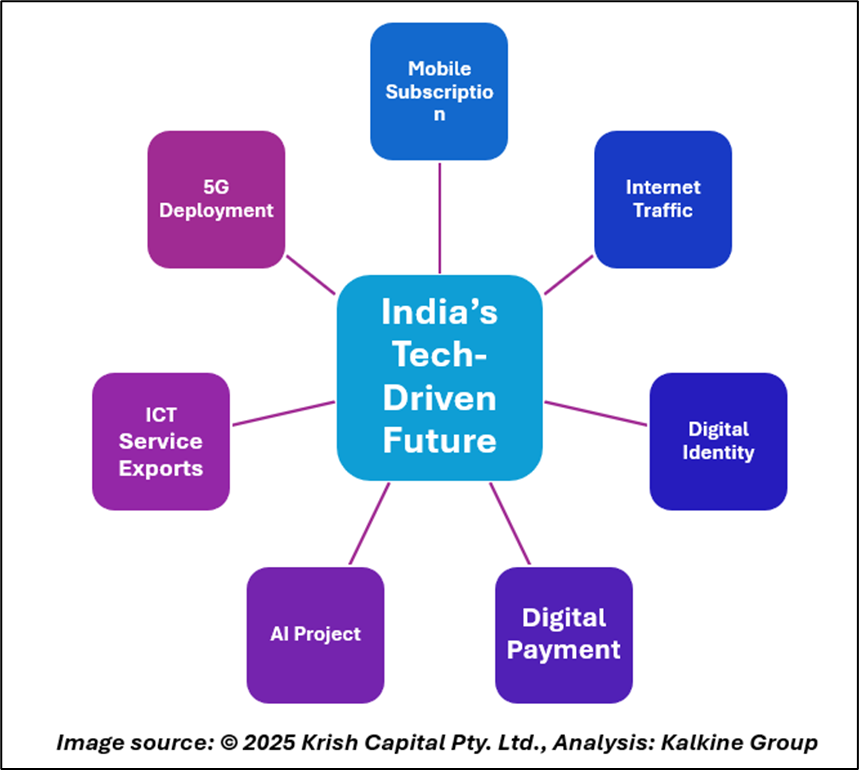
Key Contributions to Digital GVA
- Digital-Enabling Industries (7.83%): ICT services, telecom, electronics, and communication equipment manufacturing remain the largest contributors.
- New Digital Industries (~2%): Big Tech-linked platforms, digital intermediaries, and ecosystem enablers.
- Digital Contribution of Traditional Sectors (~2%): Banking, financial services, insurance, retail trade, and education are rapidly digitizing, matching the scale of new-age businesses.
This illustrates how India’s digital economy is expanding beyond ICT, permeating mainstream industries through platform adoption and digital diffusion.
Employment Impact
In FY23, the digital economy supported 14.67 million workers, or 2.55% of India’s workforce. Employment is expected to expand significantly as digital platforms scale and traditional sectors deepen adoption of technology.
Growth Outlook
The digital economy is expected to grow nearly twice as fast as overall GDP. In the near term, momentum will stem from:
- Expansion of digital platforms and intermediaries.
- Wider digital adoption across legacy industries.
- Increased policy support for digital public infrastructure (DPI).
By 2030, India’s digital economy is projected to emerge as a key driver of growth, contributing one-fifth of national income.
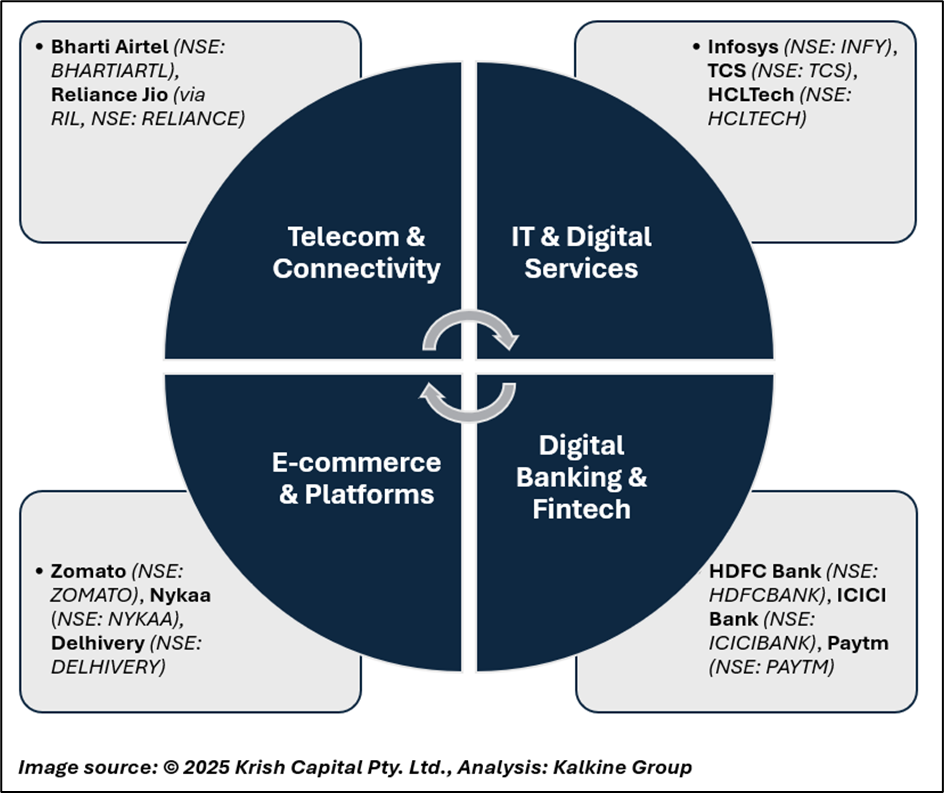
Investor Perspective – Listed Stocks Benefiting from Digital Growth
Conclusion
India’s digital economy has reached a critical inflection point, now contributing over ₹31 lakh crore to GDP. With its share set to rise to 20% by 2030, the digital wave is no longer confined to ICT but is reshaping every sector. For policymakers, this provides a roadmap to support innovation and infrastructure. For investors, it highlights long-term opportunities in India’s listed digital leaders and enablers.